

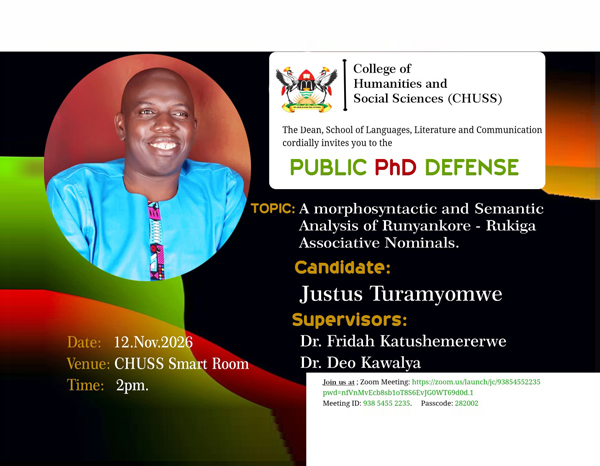
The Dean, School of Languages, Literature and Communication, cordially invites you to the Public PhD Defense for Mr Turamyomwe Justus, scheduled on November 12, 2026, starting at 2pm in the CHUSS Smart Room.
Abstract:
The study examines the morphosyntactic properties and semantic functions of Runyankore-Rukiga associative nominals. Despite their unique properties, derivation, and semantic functions, Runyankore-Rukiga associative nominals have received less scholarly attention. The study describes the properties of Runyankore-Rukiga associative nominals; accounts for their derivation, and analyzes semantic functions of associative modifiers. The study is fully qualitative, and employs a descriptive analytical design. The Makerere Nkore-Kiga and Runya corpora, as well as elicitation are sources of data. The typology of Bantu canonical connective construction and the theory of complex nominals are adopted as analytical frameworks for the study. Findings reveal that the properties of Runyankore-Rukiga associative nominals mainly conform to the Bantu canonical connective constructions with regard to marking, the canonical order, and the modifier properties; nevertheless, subtle differences exist. The study establishes that marked Runyankore-Rukiga associative nominals use -a, and -nya-.as associative markers as opposed to the Bantu canonical connective constructions that use -a as the only canonical marker. In addition, the order of Runyankore-Rukiga associative nominals slightly differs from the Bantu canonical connective construction since the head noun and the associative marker are optional elements in Runyankore-Rukiga. Unlike the marked associative nominals which employ -a and -nya-, the unmarked ones use juxtaposition and lexical marking. Further, the study reveals that to a large extent, overt associative nominals are accounted for by transformational rules suggested in the theory of complex nominals, while unmarked associative nominals show zero derivation. More so, the recoverably deletable predicates determine the semantic function of Runyankore-Rukiga associative modifiers. Overall, the properties identified in Runyankore-Rukiga associative nominals are comparable to those of Bantu associative nominals though micro variations exist. The theory of complex nominals accounts for the derivation of Runyankore-Rukiga associative nominals with few exceptions that are not applicable to the Runyankore-Rukiga case. The predicates specified in the theory of complex nominals help to identify the semantic functions of Runyankore-Rukiga associative modifiers. The study contributes to scholarship by modifying the canonical order of associative nominals from Head-Relator-Dependent to (Head)-(Associative marker)-Modifier so as to accommodate the specific unique features in Runyankore-Rukiga. The study, further, modifies the theory of complex nominals to account for the unique derivational features (insertion and elision) manifested in Runyankore-Rukiga. In addition, it provides a systematic way of identifying the semantic functions of associative modifiers that have been traditionally termed as possessors or genitives. To terminologists and researchers, this study gives insights into the processes of term formation in Runyankore-Rukiga in particular and Bantu languages in general.
Download: Turamyomwe Justus_Abstract